Running OpenVAS Is Easy. Managing Vulnerabilities Is Not.
Vulnerability scanning is widely adopted, yet many organizations struggle to reduce risk despite running regular scans. Without governance, prioritization, and ownership, vulnerability data becomes noise.
Why this matters.
Vulnerability scanning is widely adopted, yet many organizations struggle to reduce risk despite running regular scans. Without governance, prioritization, and ownership, vulnerability data often becomes noise rather than actionable insight.
1. Vulnerability scanning is a signal, not a solution.
Tools like OpenVAS identify system and software vulnerabilities by mapping them to CVE (Common Vulnerabilities and Exposures) identifiers, which serve as unique references for publicly known cybersecurity flaws affecting software and hardware.
OpenVAS also uses the CVSS (Common Vulnerability Scoring System) to assign severity levels to vulnerabilities discovered during scans. CVSS scores help security teams estimate the likelihood of exploitation and the potential technical impact, allowing administrators to prioritize remediation efforts.
However, a vulnerability identified through a CVE or scored through CVSS does not automatically translate into business impact. Technical severity alone cannot determine how damaging a vulnerability might be within a specific organizational environment.
For this reason, vulnerability scanning should be paired with asset classification and business context. Identifying which systems are critical to operations helps organizations prioritize remediation more effectively and prevents teams from experiencing alert fatigue caused by large volumes of low-impact findings.
2. Common failure patterns in OpenVAS environments.
One of the most common issues in vulnerability management programs is that scans are executed primarily for compliance purposes, while the results receive little operational follow-up.
In some environments, scans are simply run across the entire network without proper asset classification or risk prioritization. As a result, organizations generate extensive vulnerability reports but struggle to translate the findings into actionable remediation.
Another frequent challenge is the lack of clear remediation ownership. Even when vulnerabilities are identified and classified, it may remain unclear who is responsible for addressing them. Without defined ownership and accountability, the same vulnerabilities often appear in reports month after month without meaningful resolution.
These patterns illustrate how vulnerability scanning alone cannot significantly improve an organization's security posture without a supporting management process.
3. Why governance matters more than scan frequency.
Regular vulnerability scanning is important because new vulnerabilities are continuously discovered. However, increasing scan frequency alone does not significantly reduce risk if organizations lack a governance structure to manage the results.
Effective vulnerability management requires clear processes that define:
- Who is responsible for remediation
- How vulnerabilities are prioritized
- When risks should be accepted versus remediated
Organizations often balance risk remediation and risk acceptance depending on operational constraints, potential business impact, and system criticality.
In addition to CVSS scores, organizations should evaluate factors such as system exposure, asset importance, and operational dependency when prioritizing vulnerabilities. Governance frameworks help translate raw vulnerability data into structured risk management decisions.
4. Practical steps to make OpenVAS actually useful.
To obtain real value from vulnerability scanning tools like OpenVAS, organizations should integrate scanning into a broader vulnerability management process.
Some practical steps include:
Define asset criticality Organizations should classify assets based on their importance to operations and the potential business impact of disruption.
Assign remediation ownership Each vulnerability category or system should have a designated owner responsible for remediation and tracking progress.
Track vulnerability trends over time Instead of focusing only on individual scan results, organizations should analyze trends across multiple scans to understand how vulnerabilities evolve across systems and software.
Integrate scanning into continuous security processes Vulnerability scanning should be treated as part of an ongoing risk management process rather than a standalone event performed only for compliance purposes.
When implemented correctly, vulnerability scanning becomes a proactive security capability rather than simply a reporting exercise.
5. Where this fits in modern security programs.
In modern cybersecurity programs, vulnerability scanners like OpenVAS function as one input within a broader risk management strategy.
Scanning tools provide visibility into technical weaknesses, while governance processes translate those findings into prioritized actions. When combined with asset management, remediation workflows, and risk evaluation, vulnerability scanning contributes to both security resilience and operational continuity.
Rather than serving solely as a compliance requirement, vulnerability management programs help organizations strengthen their overall security posture and reduce exposure to evolving threats.
Conclusion
Vulnerability scanners like OpenVAS are powerful tools when used intentionally. Without governance and accountability, they can generate large volumes of data without meaningfully reducing risk.
When vulnerability scanning is aligned with asset management, remediation ownership, and risk management processes, it becomes a valuable component of a mature cybersecurity program and supports the broader goal of operational resilience.
If you're interested in deploying OpenVAS securely using Docker with HTTPS, I covered that process in a previous post.
Related posts
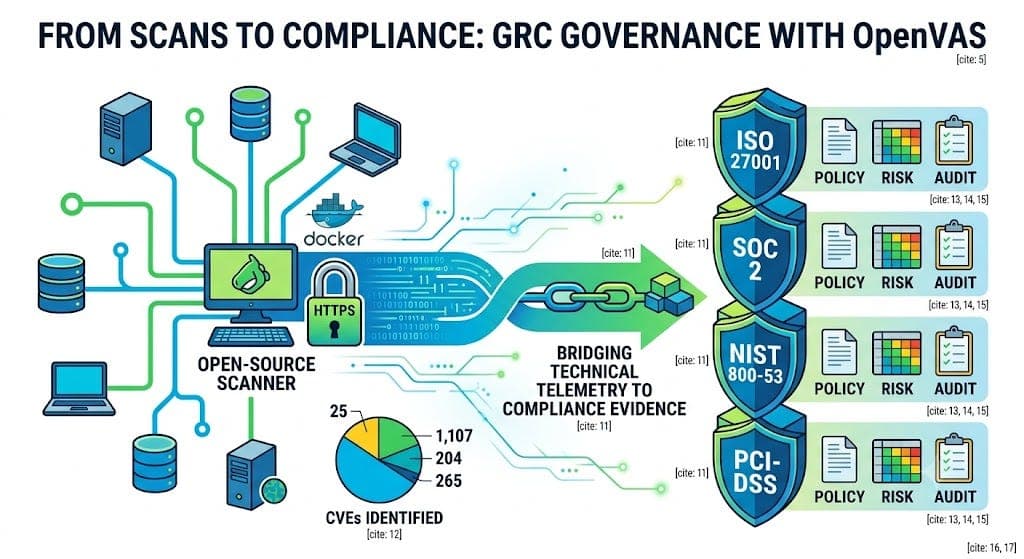
Bridging Technical Scanning to Enterprise Governance: How Open-Source Vulnerability Management Drives GRC Compliance
How open-source vulnerability scanning workflows transform raw system telemetry into auditable compliance evidence across ISO 27001, SOC 2, NIST SP 800-53, and PCI-DSS.
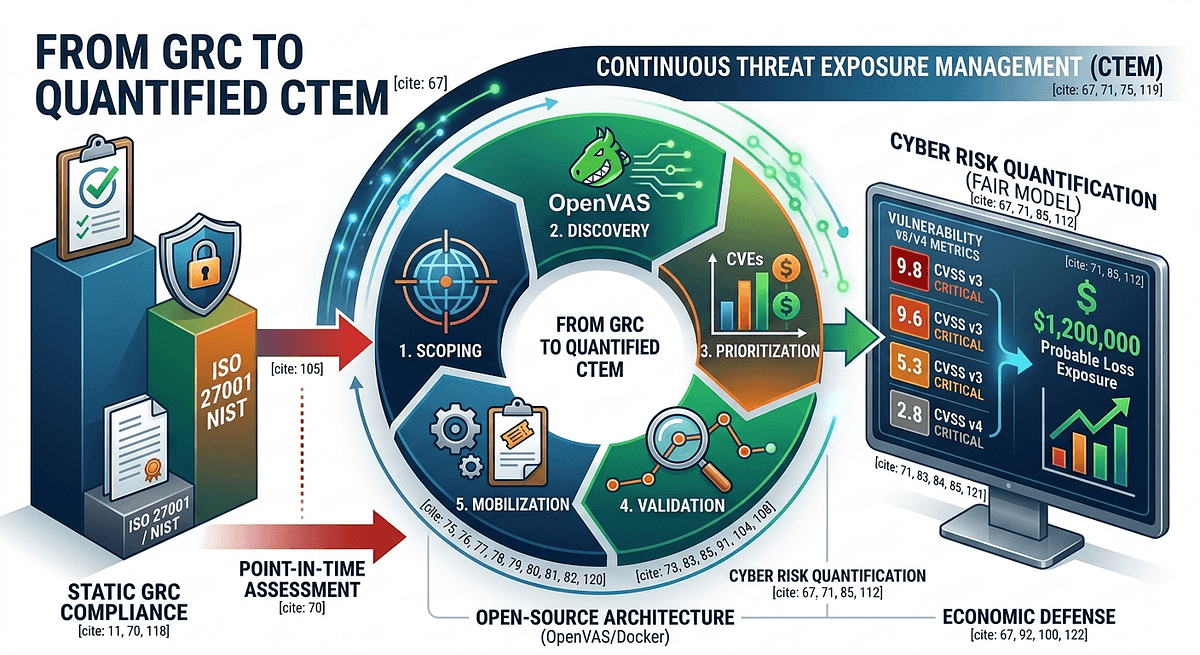
From GRC Compliance to Continuous Exposure Management: Quantifying Cyber Risk with Open-Source Architecture
Introducing a Continuous Threat Exposure Management (CTEM) framework integrated with FAIR cyber risk quantification: moving from static GRC compliance to continuous, board-level risk visibility.
OpenVAS Vulnerability Scanner on Ubuntu 24.04: Docker Deployment with HTTPS
How to run OpenVAS (GVM) in Docker with HTTPS on Ubuntu 24.04: consolidating the working steps where Greenbone's own documentation is partially outdated.
Comments
No comments yet. Be the first.