Bridging Technical Scanning to Enterprise Governance: How Open-Source Vulnerability Management Drives GRC Compliance
How open-source vulnerability scanning workflows transform raw system telemetry into auditable compliance evidence across ISO 27001, SOC 2, NIST SP 800-53, and PCI-DSS.
Executive Summary
In modern enterprise cybersecurity, a structural divide frequently persists between technical operational engineering and strategic governance. In my previous technical guides, OpenVAS Vulnerability Scanner on Ubuntu 24.04: Docker Deployment with HTTPS and Running OpenVAS Is Easy. Managing Vulnerabilities Is Not., we addressed the mechanics of deploying secure scanning infrastructure and organizing technical remediation workflows.
However, running scans and assigning tickets only addresses half the equation. To achieve true cyber resilience, vulnerability management must directly inform Governance, Risk, and Compliance (GRC) frameworks.
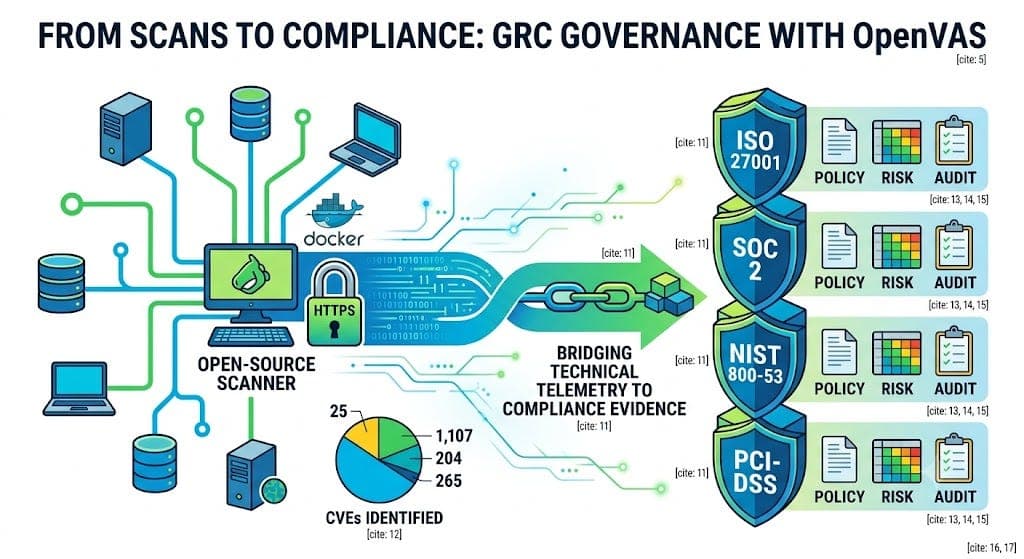
This article details how open-source vulnerability scanning engine workflows transform raw system telemetry into auditable compliance evidence across major regulatory frameworks (ISO 27001, SOC 2, NIST SP 800-53, and PCI-DSS), establishing a scalable bridge between engineering operations and national cyber-defense standards.
1. The GRC Gap: Why Technical Telemetry Fails Compliance Audits
Engineering teams measure vulnerability management through operational metrics: total Common Vulnerabilities and Exposures (CVEs) identified, Mean Time to Detect (MTTD), and Mean Time to Remediate (MTTR). Conversely, compliance committees and external auditors speak in terms of policy adherence, risk posture, control mapping, and business risk mitigation.
The Core Problem: Technical teams view scans as a list of patches to apply; GRC teams view scans as evidentiary proof that control policies are actively enforced. Without a structural bridge between these domains, organizations suffer from compliance drift and unquantified systemic risk.
When open-source tooling like OpenVAS (Greenbone Vulnerability Management) is deployed without GRC integration, vulnerability data remains siloed in technical dashboards, failing to satisfy the mandatory risk governance requirements imposed on critical infrastructure and national enterprise supply chains.
2. Mapping OpenVAS Telemetry to Federal & International Frameworks
Automated vulnerability assessment is a mandatory technical control requirement across every major security baseline. The table below illustrates how technical execution in OpenVAS translates directly into control compliance for standard enterprise frameworks:
| Compliance Baseline | Specific Control Requirement | Technical OpenVAS Implementation | Evidence Artifact for Auditors |
|---|---|---|---|
| ISO/IEC 27001:2022 | A.8.8: Management of technical vulnerabilities | Scheduled NVT/SCAP feed updates & automated network scanning | Continuous feed sync logs & historic scan delta reports |
| NIST SP 800-53 Rev. 5 | RA-5: Vulnerability Monitoring & Scanning | Credentialed scans with CVSS v3 score prioritization | Authenticated scan execution records & SLA remediation tracking |
| SOC 2 Type II | CC6.8 / CC7.1: Threat prevention & infrastructure monitoring | Docker-based containerized scanner with HTTPS encrypted transport | Encrypted transport configuration & role-based access logs |
| PCI-DSS v4.0 | Requirements 6.3 & 11.3: Vulnerability identification & internal scans | Target range definitions & automated vulnerability reporting | Historical PDF/XML scan logs with CVSS >=4.0 tracking |
By standardizing OpenVAS data exports into automated GRC pipelines, security teams convert raw network telemetry into continuous, audit-ready governance artifacts.
3. The Enterprise Blueprint: Converting Scans into Governance Controls
To elevate open-source vulnerability scanning to enterprise GRC standards, organizations must implement a four-stage integration model:
[ Automated HTTPS OpenVAS Scan ]
              |
              v
[ Raw Telemetry Extraction (XML/CSV) ]
              |
              v
[ Risk Quantification & Priority Scoring ]
              |
              v
[ GRC Mapping & Evidence Repository ] --> (SOC 2 / ISO 27001 Audit Ready)
Stage 1: Enforcing Cryptographic Scopes (Transport & Access Control)
As outlined in our deployment guide, deploying OpenVAS behind isolated Docker containers with HTTPS (using TLS 1.3 certificates and proper UID/GID privilege isolation) ensures that the scanner itself does not become an unauthenticated target. Auditors require proof that vulnerability scanning infrastructure meets the same baseline security policies as the targets it evaluates.
Stage 2: Contextual Risk Scoring (Beyond Base CVSS)
Raw Common Vulnerability Scoring System (CVSS) base metrics are inadequate for governance decisions. A 9.8 Critical vulnerability on an isolated test database presents a lower enterprise impact than a 6.5 Medium vulnerability on a public-facing payment gateway.
To align with NIST risk management guidelines, organizations must combine:
- Technical Severity: Standard CVSS v3/v4 vector.
- Asset Criticality: Business impact classification (e.g., Tier 1 Core Infrastructure vs. Tier 3 Dev).
- Threat Intelligence: Active exploitation status (EPSS: Exploit Prediction Scoring System).
Stage 3: Closed-Loop Remediation SLAs
Governance requires accountability. Remediating vulnerabilities must be bound by strict Service Level Agreements (SLAs) linked directly to framework policies:
- Critical (9.0-10.0): Immediate mitigation within 24-72 hours.
- High (7.0-8.9): Remediation within 14 business days.
- Medium (4.0-6.9): Scheduled patch cycle within 30 business days.
- Low (0.1-3.9): Risk acceptance or maintenance cycle within 90 business days.
4. National Interest & Economic Impact: The Value of Open-Source GRC
From a macro perspective, the security of national critical infrastructure relies heavily on the scalable adoption of robust risk management standards. Proprietary vulnerability management solutions often carry excessive licensing costs that prohibit small-to-medium enterprises (SMEs) and public sector organizations from achieving full GRC maturity.
Demonstrating that open-source architecture, such as Dockerized OpenVAS deployments, can be configured to meet strict federal compliance requirements (such as NIST SP 800-53 and CISA continuous monitoring guidelines) yields significant economic and operational benefits:
- Democratization of Enterprise Security: Enables resource-constrained organizations to maintain nation-state level defense baselines without exorbitant vendor lock-in.
- Supply Chain Resiliency: Ensures vendor partners across federal and commercial supply networks can produce verifiable GRC compliance artifacts.
- Reproducible Defense Models: Standardizes hardened container configurations and HTTPS delivery patterns across open-source security toolchains.
Conclusion: Continuous Compliance as a Strategic Imperative
Vulnerability scanning is not an isolated IT task; it is the fundamental input for organizational risk governance. By establishing secure, repeatable containerized deployments and mapping scanning telemetry directly to international compliance standards, cybersecurity engineers transform operational maintenance into strategic risk posture defense.
Building this link ensures that cybersecurity infrastructure remains compliant, auditable, and resilient against evolving threats across critical digital ecosystems.
Related posts
Running OpenVAS Is Easy. Managing Vulnerabilities Is Not.
Vulnerability scanning is widely adopted, yet many organizations struggle to reduce risk despite running regular scans. Without governance, prioritization, and ownership, vulnerability data becomes noise.
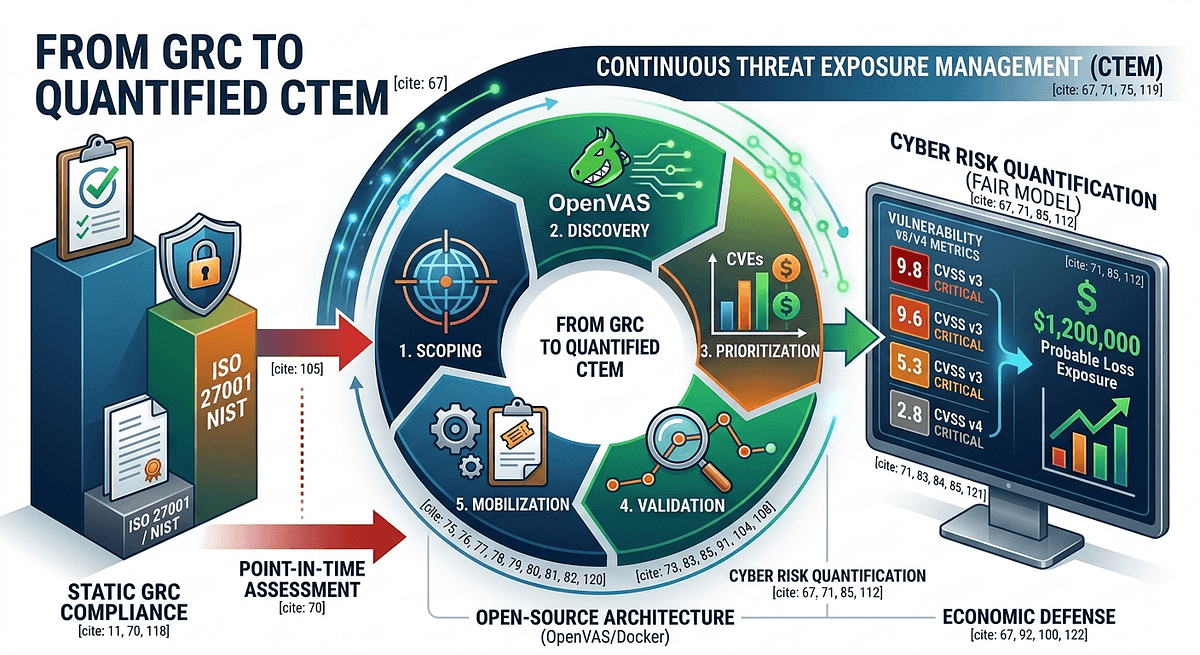
From GRC Compliance to Continuous Exposure Management: Quantifying Cyber Risk with Open-Source Architecture
Introducing a Continuous Threat Exposure Management (CTEM) framework integrated with FAIR cyber risk quantification: moving from static GRC compliance to continuous, board-level risk visibility.
OpenVAS Vulnerability Scanner on Ubuntu 24.04: Docker Deployment with HTTPS
How to run OpenVAS (GVM) in Docker with HTTPS on Ubuntu 24.04: consolidating the working steps where Greenbone's own documentation is partially outdated.
Comments
No comments yet. Be the first.