From GRC Compliance to Continuous Exposure Management: Quantifying Cyber Risk with Open-Source Architecture
Introducing a Continuous Threat Exposure Management (CTEM) framework integrated with FAIR cyber risk quantification: moving from static GRC compliance to continuous, board-level risk visibility.
Executive Summary
In our previous discussions, spanning technical containerized deployment OpenVAS Vulnerability Scanner on Ubuntu 24.04: Docker Deployment with HTTPS, operational remediation workflows Running OpenVAS Is Easy. Managing Vulnerabilities Is Not., and regulatory mapping Bridging Technical Scanning to Enterprise Governance, we established how open-source scanning engines transform raw system telemetry into auditable compliance artifacts for frameworks like ISO 27001, SOC 2, and NIST SP 800-53.
However, compliance alone does not equate to security. A check-the-box regulatory posture often relies on static, point-in-time assessments that fail to capture real-time attack surfaces or quantify financial loss exposure.
This fourth article advances the enterprise cybersecurity roadmap by introducing a Continuous Threat Exposure Management (CTEM) framework integrated with Factor Analysis of Information Risk (FAIR) cyber risk quantification. We demonstrate how open-source toolchains evolve beyond static GRC compliance to provide continuous, board-level risk visibility and financial threat modeling.
1. The Paradigm Shift: Moving from Static GRC to Continuous Threat Exposure Management (CTEM)
Traditional compliance frameworks evaluate security controls periodically. Yet, modern attack surfaces fluctuate continuously due to cloud microservices, ephemeral workloads, and evolving threat actor tactics.
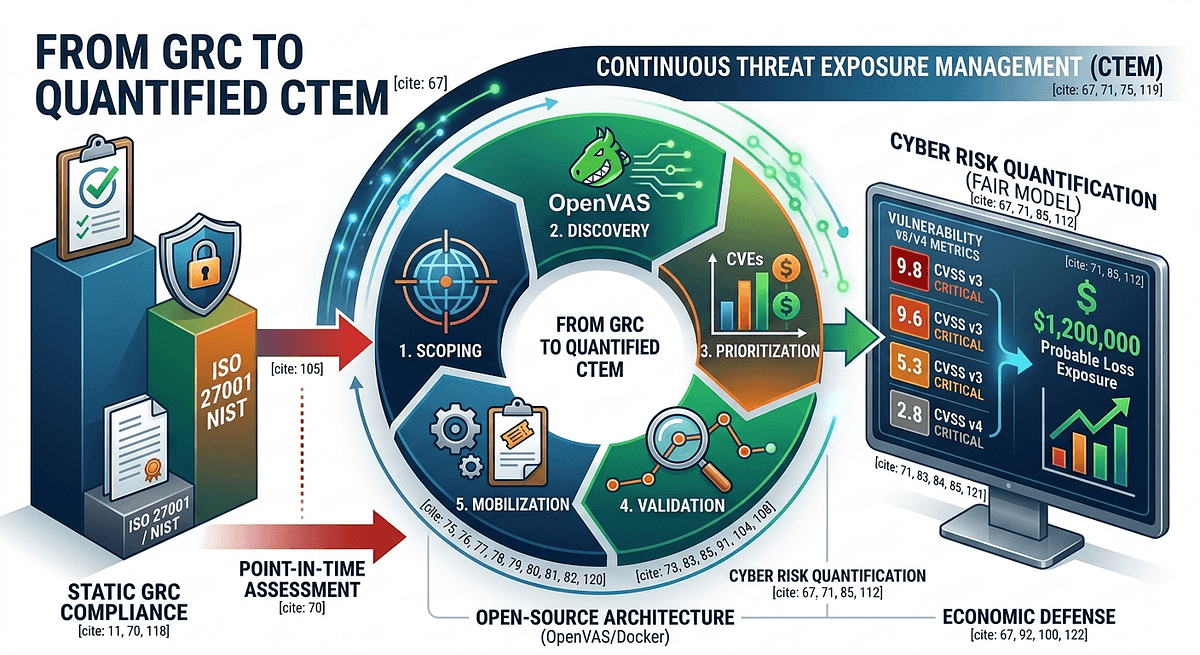
Gartner's CTEM model reframes cybersecurity from periodic patching to an ongoing, 5-stage lifecycle: Scoping, Discovery, Prioritization, Validation, and Mobilization.
[ 1. SCOPING ]
  Define critical business assets &
  regulated data scopes
        |
        v
[ 2. DISCOVERY ]
  Continuous OpenVAS engine scans &
  attack surface mapping
        |
        v
[ 3. PRIORITIZATION ]
  Contextual CVSS, EPSS scores, &
  FAIR financial modeling
        |
        v
[ 4. VALIDATION ]
  Attack path reachability check &
  exploitability testing
        |
        v
[ 5. MOBILIZATION ]
  Automated ticketing, SLA tracking,
  and GRC evidence generation
By embedding open-source vulnerability assessment directly into a continuous CTEM cycle, organizations transition from reactive vulnerability patching to proactive attack surface reduction.
2. Cyber Risk Quantification (CRQ): Translating CVEs into Financial Exposure
Board members and Chief Risk Officers rarely evaluate technical Common Vulnerabilities and Exposures (CVEs) or abstract CVSS scores alone. They require risk stated in financial impact: What is our probable loss exposure over the next 12 months?
Using the FAIR (Factor Analysis of Information Risk) framework, telemetry gathered by OpenVAS is integrated into a quantitative risk equation:
Risk (Loss Exposure) = Loss Event Frequency (LEF) x Loss Magnitude (LM)
Step-by-Step FAIR Integration
- Loss Event Frequency (LEF): OpenVAS discovery data provides vulnerability occurrence frequency across external and internal networks. When correlated with the Exploit Prediction Scoring System (EPSS), security teams determine the probability of an active exploit.
- Threat Event Frequency (TEF): Evaluates how often external threat actors attempt exploitation against exposed services.
- Loss Magnitude (LM): Quantifies financial consequences based on operational downtime, regulatory non-compliance fines (e.g., GDPR/NIS2), breach notification overhead, and legal liability.
Example Scenario: High-Severity Flaw on Internal vs. External Host
Scenario A: A 9.8 CVSS flaw on an isolated internal development database.
- Exploitability (EPSS): 0.02%
- Probable Financial Impact: <=$15,000 (Low Threat Reachability)
Scenario B: A 7.5 CVSS flaw on a public-facing e-commerce API gateway.
- Exploitability (EPSS): 68.4%
- Probable Financial Impact: $1,200,000 (High Business Interruption & Data Exposure)
Quantifying risk in monetary terms allows CISOs to justify security investments, prioritize engineering sprints, and establish objective risk tolerance thresholds.
3. The 5-Stage Open-Source CTEM Operational Blueprint
To operationalize CTEM using open-source infrastructure without vendor lock-in, security engineering teams follow this implementation architecture:
| CTEM Phase | Open-Source Tooling & Config | Technical Deliverable | Executive & GRC Value |
|---|---|---|---|
| 1. Scoping | Target definitions & container tags | Defined critical asset boundaries | Aligns security focus with business risk priorities. |
| 2. Discovery | Hardened Dockerized OpenVAS feed updates | Full spectrum vulnerability telemetry | Replaces quarterly assessments with continuous scanning. |
| 3. Prioritization | OpenVAS XML parser + EPSS API + FAIR model | Contextualized Risk-Ranked Matrix | Reduces alert fatigue by filtering non-reachable CVEs. |
| 4. Validation | Automated network reachability analysis | Verified Attack Path Intelligence | Confirms whether security controls prevent exploitation. |
| 5. Mobilization | API integration with orchestration platforms | Closed-loop SLA patch assignment | Provides auditable evidence of remediation workflows. |
4. Economic Defense & Strategic National Security Value
From an advanced cybersecurity research perspective, aligning with federal standards such as USCIS EB2-NIW criteria for national interest, establishing reproducible, low-cost risk quantification frameworks directly supports national security and economic resilience.
- Protecting Small and Mid-Sized Enterprise (SME) Supply Chains: Proprietary CTEM and risk quantification platforms often carry prohibitively expensive annual enterprise licensing fees. Leveraging open-source vulnerability engines ensures critical supply chain partners can deploy nation-state level risk management without financial barriers.
- Federal Critical Infrastructure Protection: Continuous monitoring alignment with CISA and NIST CSF 2.0 standards builds structural resilience across national energy, healthcare, and financial sector digital assets.
- Standardized Cyber Risk Metric Transparency: Replacing subjective "Red/Yellow/Green" risk heatmaps with objective, open-source data pipelines establishes rigorous, auditable cyber risk governance across federal and commercial domains.
Conclusion: Completing the Security Maturity Curve
Vulnerability management is an evolving journey across four distinct milestones:
- Deployment (Article 1): Installing secure, containerized scanning engines.
- Operations (Article 2): Executing structured remediation workflows.
- Governance (Article 3): Mapping telemetry to international GRC frameworks.
- Quantification & CTEM (Article 4): Achieving continuous threat exposure management and financial cyber risk modeling.
By integrating open-source telemetry into continuous threat exposure loops and quantitative risk models, cybersecurity leaders bridge the divide between technical engineering execution, regulatory compliance, and strategic board-level governance.
Related posts
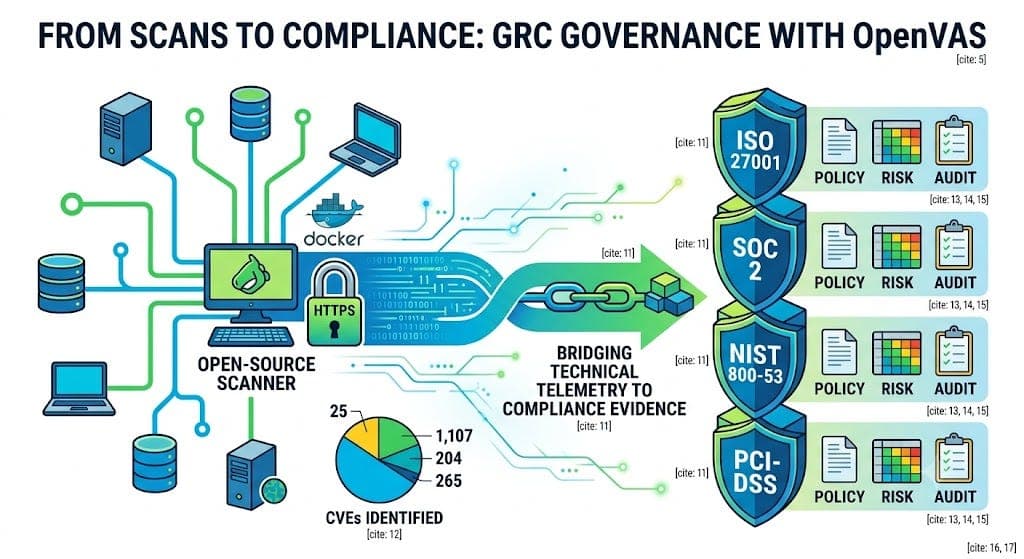
Bridging Technical Scanning to Enterprise Governance: How Open-Source Vulnerability Management Drives GRC Compliance
How open-source vulnerability scanning workflows transform raw system telemetry into auditable compliance evidence across ISO 27001, SOC 2, NIST SP 800-53, and PCI-DSS.

Running OpenVAS Is Easy. Managing Vulnerabilities Is Not.
Vulnerability scanning is widely adopted, yet many organizations struggle to reduce risk despite running regular scans. Without governance, prioritization, and ownership, vulnerability data becomes noise.
OpenVAS Vulnerability Scanner on Ubuntu 24.04: Docker Deployment with HTTPS
How to run OpenVAS (GVM) in Docker with HTTPS on Ubuntu 24.04: consolidating the working steps where Greenbone's own documentation is partially outdated.
Comments
No comments yet. Be the first.