Vulnerability Management: Find It, Prioritize It, Patch It
A practical look at the unglamorous discipline that decides whether known flaws get fixed before or after they're exploited
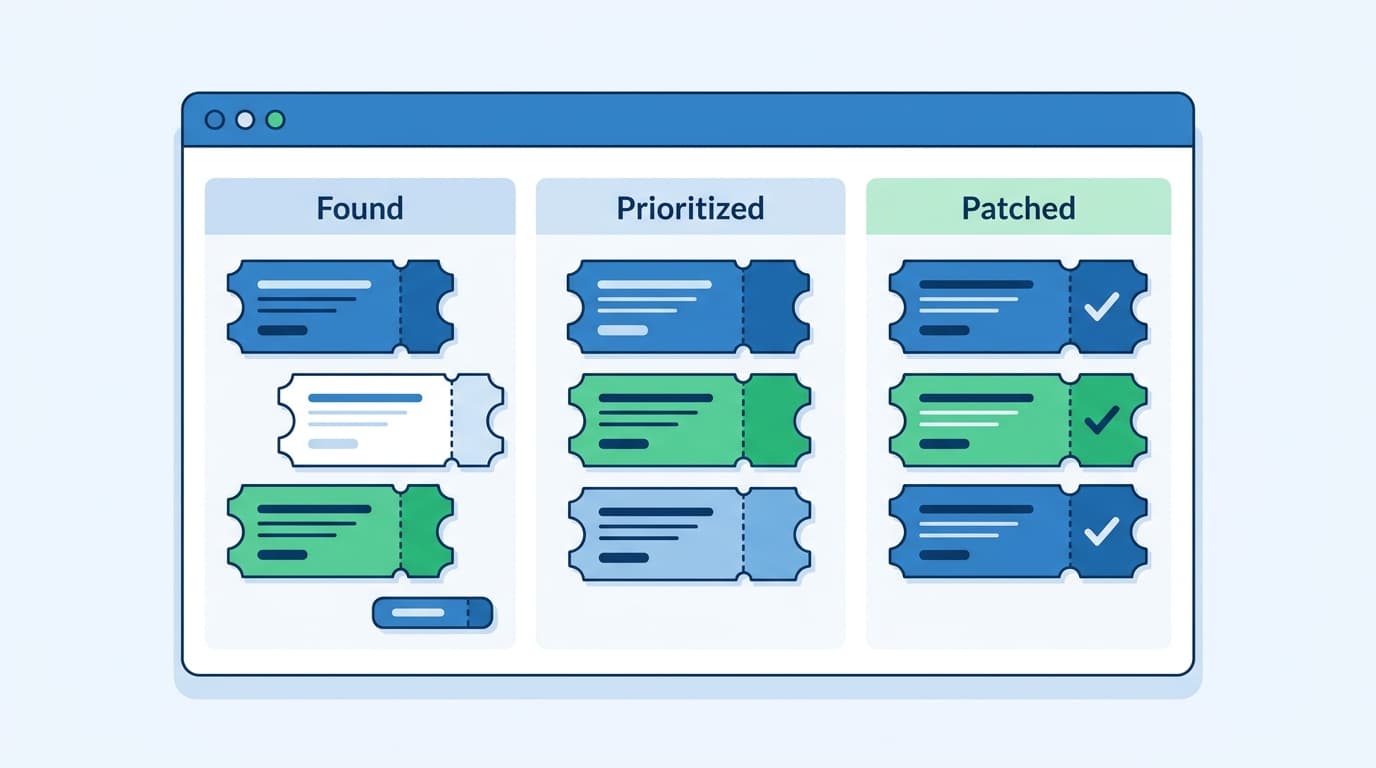
Every piece of software has vulnerabilities. That's not a cynical statement; it's just the reality of building complex systems out of code written by fallible humans, layered on top of other code written by other fallible humans, some of whom stopped maintaining their project years ago. The question that actually separates resilient organizations from vulnerable ones was never 'do we have vulnerabilities'; it's 'do we know about them, and how fast do we close the gap once we do.' That is the entire discipline of vulnerability management, and it's one of the least glamorous, most consistently underfunded parts of any serious security program.
I want to walk through vulnerability management as a practical, three-stage process: find it, prioritize it, patch it, because treating it as a single monolithic task is exactly how organizations end up with scanning tools that generate thousands of alerts nobody acts on. Each stage has its own failure modes, and getting all three right is what actually moves the needle.
Finding: you can't fix what you don't know about
The first stage sounds obvious but is where a surprising number of organizations quietly fail: maintaining an accurate, current inventory of what you actually have running. Vulnerability scanners, dependency-checking tools, and asset-discovery platforms are all only as good as the inventory they're pointed at. A server nobody remembers exists, a forgotten development environment still reachable from the internet, a mobile app dependency nobody's updated since the project shipped: these are exactly the assets that don't get scanned, because they've fallen off the map entirely. Unknown assets are the single biggest blind spot in most vulnerability management programs, and no amount of scanning sophistication compensates for scanning the wrong list.
I've found it useful to think of asset inventory less like a spreadsheet exercise and more like a living map that has to be actively maintained against constant organizational drift; new services get spun up, old ones get decommissioned in name but not always in practice, and ownership changes hands as teams reorganize. Treating the inventory as a one-time project rather than an ongoing discipline is one of the quieter but more consequential mistakes an otherwise well-intentioned security program can make.
Once the inventory is solid, finding vulnerabilities becomes a matter of layering the right tools: static analysis on your own code, software composition analysis on your third-party dependencies, network and configuration scanning on your infrastructure, and, critically, actually reading the security advisories published for every piece of software you depend on, rather than waiting for an automated scanner to catch up. Public vulnerability databases and vendor advisories are often the fastest source of truth, faster than any scanner's next scheduled run.
Unknown assets are the single biggest blind spot in most vulnerability management programs: no scanning tool fixes a list that's missing entries.
A pattern worth naming explicitly: shadow IT and forgotten infrastructure tend to accumulate quietly in exactly the organizations that feel most confident about their security posture, because confidence often comes from looking at the systems everyone remembers, not the ones that have drifted out of anyone's regular attention. A test environment spun up for a proof of concept two years ago and never decommissioned. A third-party integration configured by a team that has since turned over entirely. A mobile app dependency added for one feature that was later removed, but the dependency itself was never cleaned out of the build. None of these show up in a security review that only looks at what's actively documented, which is exactly why periodic, deliberate asset-discovery exercises, not just relying on whatever inventory a scanning tool was already pointed at, remain one of the highest-value, lowest-glamour activities a security program can invest time in.
Prioritizing: not every finding deserves the same response
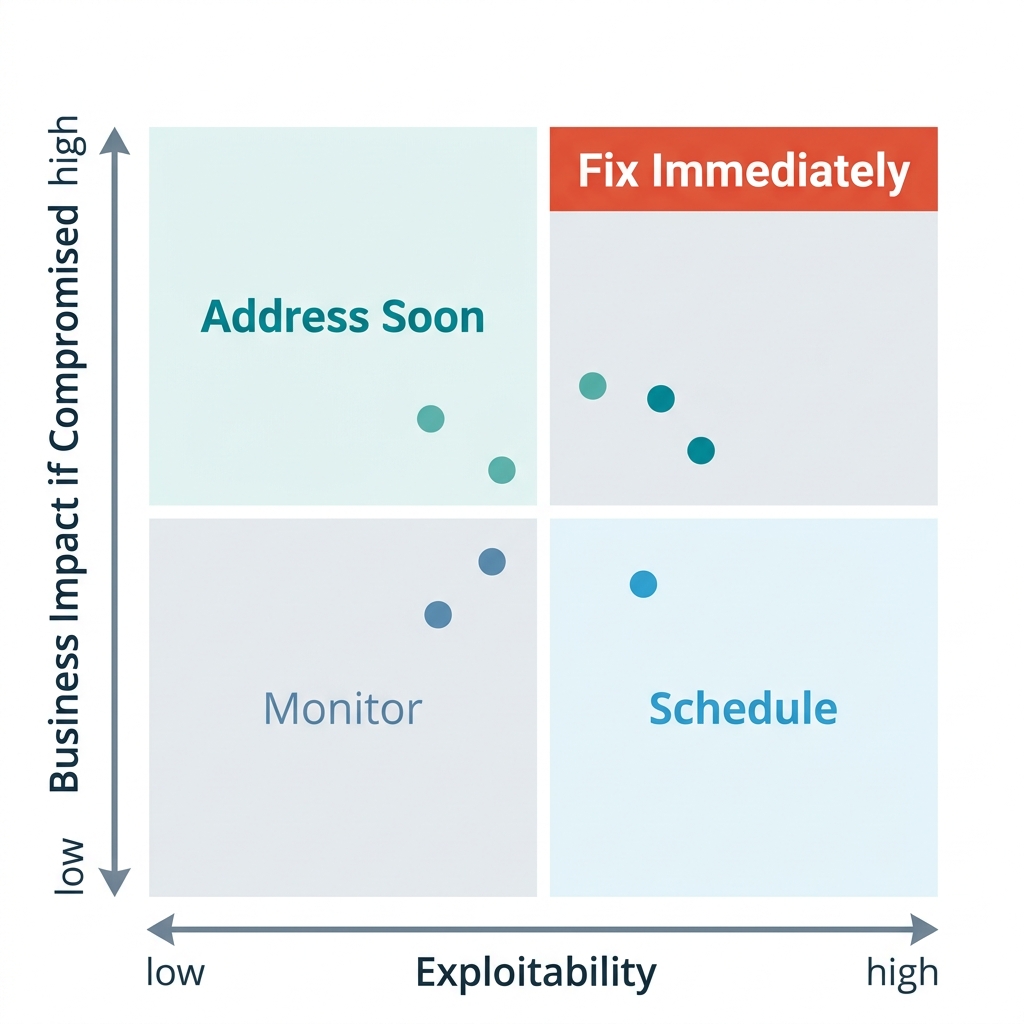
This is the stage where most vulnerability management programs actually break down, and it's rarely because they aren't finding enough issues: it's the opposite. A mature scanning program can easily generate hundreds or thousands of findings a month, and treating every one of them as equally urgent guarantees that the team either burns out or, more commonly, starts ignoring the alerts altogether. Prioritization is what turns a firehose of findings into an actionable list, and it requires more nuance than just sorting by a severity score.
A useful prioritization framework weighs several factors together, not any single one in isolation: the severity of the vulnerability itself, whether a working exploit is publicly known or actively being used in the wild, whether the affected asset is exposed to the internet or only reachable internally, and how sensitive the data or function behind that asset actually is. A theoretically severe vulnerability on an internal, air-gapped test system with no sensitive data is a very different priority than a moderate vulnerability on a public-facing system that processes customer payment information. Getting this calibration right is what allows a team with finite time to spend that time on the fixes that actually reduce risk, rather than the fixes that happen to sort to the top of a raw severity list.
The role of threat intelligence in staying ahead
Beyond your own scanning and inventory, a mature vulnerability management practice keeps an active ear on what's happening in the broader threat landscape, not just what's happening inside your own environment. Threat intelligence feeds, vendor security bulletins, and industry information-sharing groups all provide an early warning system that internal scanning alone can't replicate: by the time your own scanner flags a vulnerability as present in your environment, that vulnerability may have already been publicly known, and potentially already being actively exploited, for days or weeks.
This is particularly important for what security professionals call zero-day and n-day vulnerabilities, flaws that are newly disclosed, sometimes before a patch even exists, where every hour of delay in awareness translates directly into additional exposure window. An organization that only learns about a critical vulnerability through its own quarterly scan cycle is, by definition, always going to be behind an organization that's actively monitoring disclosure channels for the specific technologies it depends on. This doesn't require an expensive, dedicated threat-intelligence function for most organizations: it can be as straightforward as subscribing to the security advisory mailing lists for every major piece of software and infrastructure the organization actually runs, and having a defined, fast path for triaging what comes through those channels the same day it arrives.
Patching: closing the gap without breaking what works
Finding and prioritizing accomplish nothing if the organization can't actually apply the fix in a reasonable timeframe. This is where vulnerability management collides with the very real, very legitimate fear of breaking production systems; a patch that closes a security hole but takes down a critical service is not obviously a win, and this tension is exactly why many organizations end up patching far slower than their own risk tolerance would suggest if asked directly.
The organizations that patch well tend to invest in the infrastructure that makes patching safe rather than scary: staged rollout environments that mirror production closely enough to catch regressions before they reach real users, automated test suites that give confidence a patch didn't break core functionality, and rollback plans that are tested before they're needed, not improvised during an incident. None of this is exotic engineering: it's the same discipline that supports any safe deployment process, just aimed specifically at the category of changes that closes known security gaps. Speed and safety in patching aren't actually in tension once this infrastructure exists; they're only in tension when an organization is patching for the first time on a system that was never built to be updated with confidence.
- Maintain an accurate, current asset inventory: an unknown asset is a permanent blind spot no scanner can fix
- Layer multiple discovery sources: your own code, third-party dependencies, infrastructure configuration, and published advisories
- Prioritize by combining severity, real-world exploitability, exposure, and the sensitivity of what's behind the vulnerable asset
- Invest in safe-deployment infrastructure (staging environments, automated tests, tested rollback plans) so patching fast doesn't mean patching recklessly
Communicating risk to people who aren't security specialists
A vulnerability management program can be technically excellent and still struggle if the people who control budget, timelines, and competing priorities never understand why a given fix matters. A raw severity score or a CVE identifier means very little to a business stakeholder deciding whether to delay a product launch to accommodate a patch. Translating technical risk into business terms, such as what could actually happen if this isn't fixed, how likely that outcome is, and what it would cost the organization if it happened, is a skill that's just as important as the technical work of finding and triaging the vulnerability in the first place.
The security teams I've seen earn genuine organizational trust and get their remediation requests approved quickly are the ones who've learned to make this translation consistently: not exaggerating risk to force action, and not underselling it to avoid an uncomfortable conversation, but giving decision-makers an honest, concrete picture of what's actually at stake. This also works in the other direction: it builds the credibility that makes it possible to occasionally say 'this one really can wait' without being ignored the next time something genuinely urgent comes up. A vulnerability management function that cries wolf on every finding trains its own stakeholders to stop listening, which is its own kind of security failure.
Building a remediation culture with real accountability
Beyond the technical tooling, the organizations that patch fastest and most reliably tend to have built something less technical but more important: a genuine culture of accountability around remediation timelines. This usually takes the shape of a clearly defined service-level target (critical vulnerabilities remediated within a set number of days, high-severity findings within a longer but still bounded window), paired with visible tracking of how well the organization is actually meeting those targets, reported the same way any other operational metric would be.
What makes this work isn't the existence of the target itself; plenty of organizations have a documented SLA for patching that nobody actually enforces. What makes it work is visible ownership: a named person or team accountable for each open finding, a working escalation path when a fix is at risk of missing its window, and leadership that treats a missed remediation target with the same seriousness as a missed product deadline, rather than as a lower-priority concern that can quietly slip. Vulnerability management, in other words, needs the same organizational muscle that makes any other commitment reliable: clear ownership, visible tracking, and consequences for silence. Without that muscle, even the best scanning and prioritization tooling in the world produces a list of findings that nobody feels truly responsible for closing.
Why this discipline is a mindset, not a project
The biggest mistake I've seen organizations make with vulnerability management is treating it as a project with an end state: run the big scan, fix the backlog, declare victory, rather than a continuous operating discipline. New vulnerabilities are discovered in existing, unchanged software constantly, because security research never stops and neither does the discovery of flaws in code that's been running quietly for years. A system that was fully patched last quarter can have a critical, actively-exploited vulnerability disclosed against it tomorrow, through no fault of anything your team did wrong.
This is why the healthiest vulnerability management programs I've seen are built as an ongoing rhythm rather than a periodic scramble: routine scanning on a fixed cadence, a standing process for triaging what comes back, clear ownership for who actually applies each fix, and honest metrics, such as mean time to remediate and the percentage of critical findings closed within target windows, that make the health of the program visible to people outside the security team. Vulnerability management done well is quiet, unglamorous, and constant. It rarely makes headlines when it works. It only makes headlines when it doesn't.
Finding, prioritizing, and patching are each their own skill, and each has its own way of failing silently if under-resourced. Together, they form the operational backbone that turns 'we know software has bugs' from a fatalistic shrug into an actual, manageable practice, one that keeps the gap between a flaw existing and a flaw being fixed as small as an organization's discipline allows.
Coming up next: Why Process Beats Heroics: how an organized development process prevents exactly the kind of chaos that lets vulnerabilities slip through in the first place.
Related posts
Compounding Discipline: How It All Reinforces Itself
Why security, process, and planning don't work as well in isolation as they do together
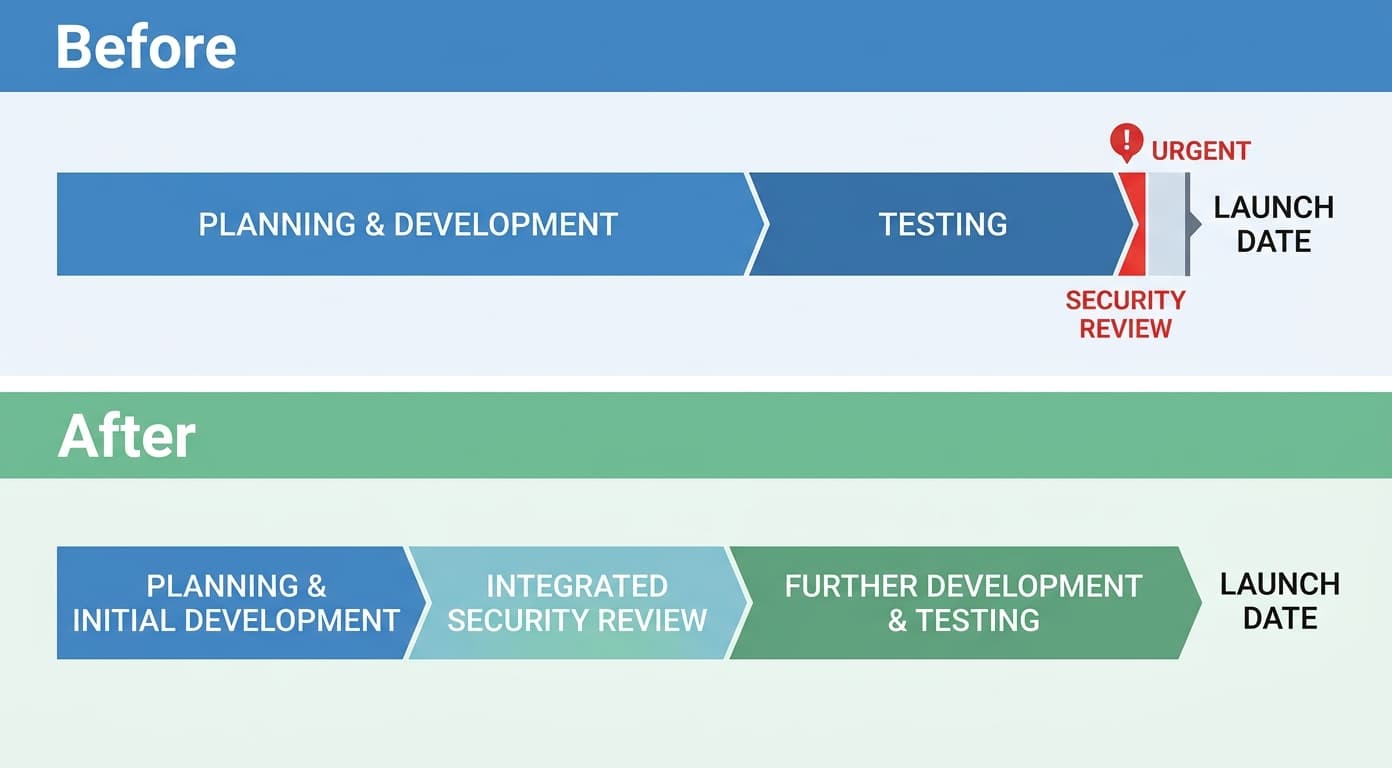
The Overlooked Power of Project Management in Engineering
Why the discipline that keeps a project organized is, quietly, also a security and quality discipline

Why Cybersecurity Actually Matters
Beyond the headlines: what's really at stake, and why it's everyone's job, not just the security team's
The Discipline of Input Validation
Why trusting input is how systems break, and why validation is the cheapest security control you'll ever implement
Why Process Beats Heroics in Software Development
An organized development process isn't bureaucracy; it's what keeps quality and security from depending on any one person's memory
Comments
No comments yet. Be the first.